Fake COD Orders in Algeria: 8 Real Attack Patterns and 7 Layers to Protect WooCommerce
It is two o’clock in the morning. Your WooCommerce store suddenly receives a burst of orders from several Algerian wilayas. The customer names look believable, the phone numbers resemble valid Algerian numbers, and the products and variations are selected correctly.
The next morning, nobody answers. Some phone numbers are invalid. Other numbers belong to real people who say they have never visited your store and never placed an order.
This is one of the patterns merchants may encounter when dealing with fake COD orders in Algeria. It could be an automated bot attack, deliberate abuse, identity misuse, or a series of orders placed with no real buying intention.
However, not every failed Cash on Delivery order is fraud. Poor checkout design, unclear shipping fees, incorrect customer data, and weak delivery coordination can create exactly the same result.
Quick summary
Fake COD orders in Algeria are not limited to random phone numbers. WooCommerce stores may face automated submissions, mass-order attacks, duplicate orders, competitor sabotage, identity misuse, prank customers, and buyers who confirm an order before refusing the parcel.
Effective protection cannot depend on one CAPTCHA or one confirmation call. It requires several layers: data validation, anti-bot controls, phone verification, confirmation before dispatch, customer-history analysis, delivery and return tracking, and campaign-quality measurement.
Table of contents
- Why Cash on Delivery carries more risk
- The three families of bad orders
- Eight real attack and abuse patterns
- Attack, warning sign, damage, and protection
- Abandoned checkout or fake order?
- Seven layers of WooCommerce COD protection
- What WooCommerce does and does not protect
- Where Yaxii Smart Form fits
- A fifteen-minute security audit
- Blacklists, privacy, and false positives
- Frequently asked questions
Why Cash on Delivery carries more operational risk
With an online card payment, the transaction is normally authorized before the merchant prepares and ships the order. With Cash on Delivery, the store carries the risk through the entire operational chain:
- capturing the customer’s information;
- confirming the order;
- reserving stock;
- preparing the parcel;
- sending it to a delivery provider;
- attempting delivery;
- handling a possible return.
An order can therefore look valid inside WooCommerce without ever becoming a completed sale.
The cost is not limited to shipping. Bad COD orders can also cause:
- hours spent calling unreachable numbers;
- inventory reserved for demand that does not exist;
- unnecessary parcel preparation;
- outbound and return shipping costs;
- distorted advertising reports;
- confusing WooCommerce order lists;
- real customers being lost inside operational noise.
The issue should not be treated as a simple checkout-field problem. It is a combined security, data-quality, confirmation, and delivery-workflow problem.
For the broader setup process, read our guide to building a WooCommerce Cash on Delivery store in Algeria.
The three families of bad COD orders
Many merchants put every undelivered order into one category: “fake order.” That makes it much harder to identify the actual cause.
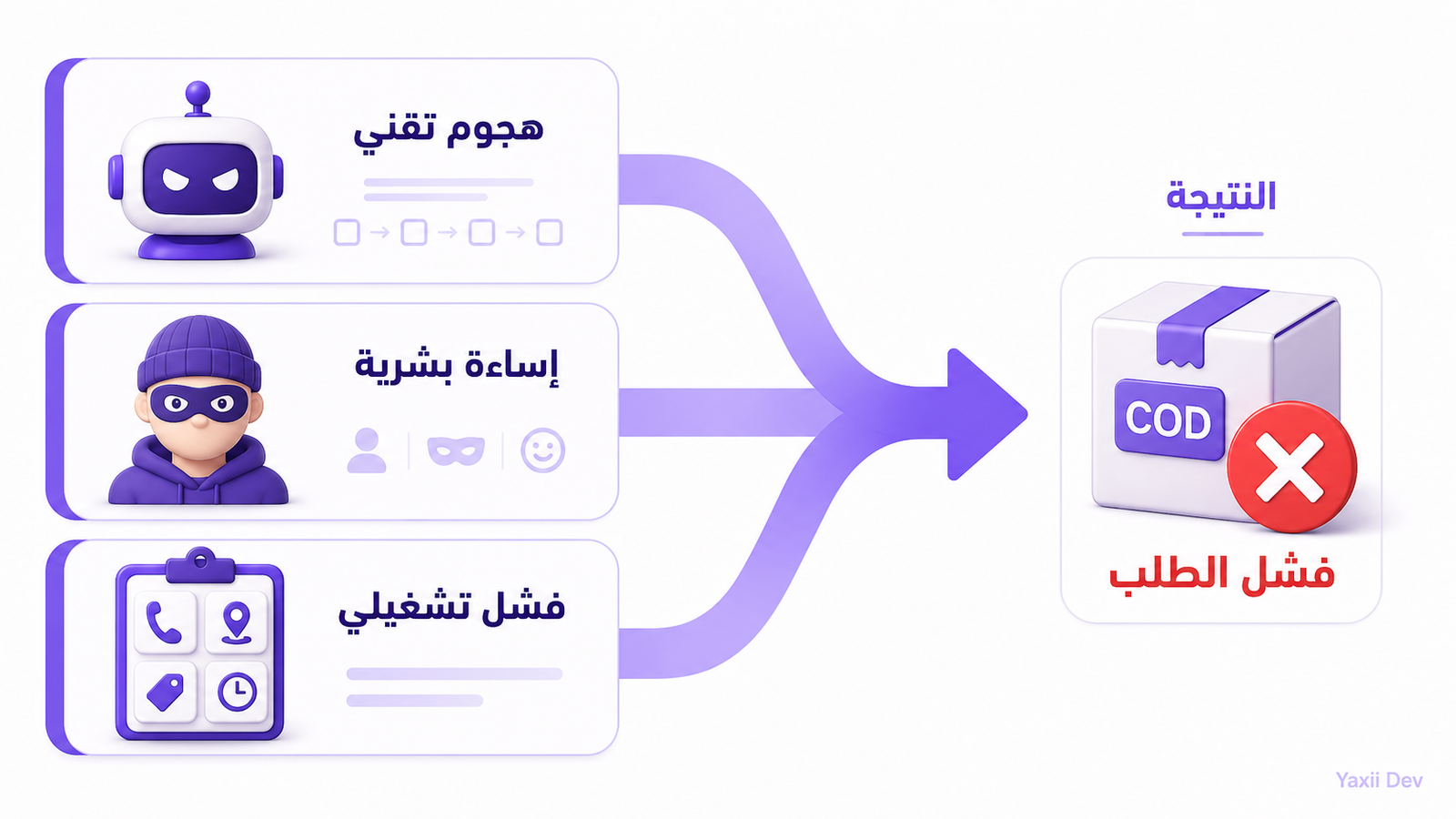
In practice, problematic COD orders usually belong to one of three families.
1. Technical attacks
A technical attack uses scripts, bots, automated browser tools, or repeated API requests to submit a checkout at a speed or volume that a normal customer could not produce.
The objective may be to create backend noise, reserve stock, increase server load, or trigger a large number of useless orders.
2. Deliberate human abuse
A real person manually completes the order without a serious intention to buy. Common examples include:
- prank orders;
- competitors attempting to waste time or shipping budget;
- someone using another person’s contact details;
- customers ordering the same item from several stores;
- repeat buyers who confirm and then refuse parcels.
3. Operational failures
Some orders fail even though the buyer originally had a genuine intention to purchase.
Common reasons include:
- shipping costs appearing too late;
- the final total being unclear;
- a mistyped phone number;
- the wrong wilaya or commune;
- an address field that is too vague;
- slow dispatch;
- poor coordination with the delivery provider.
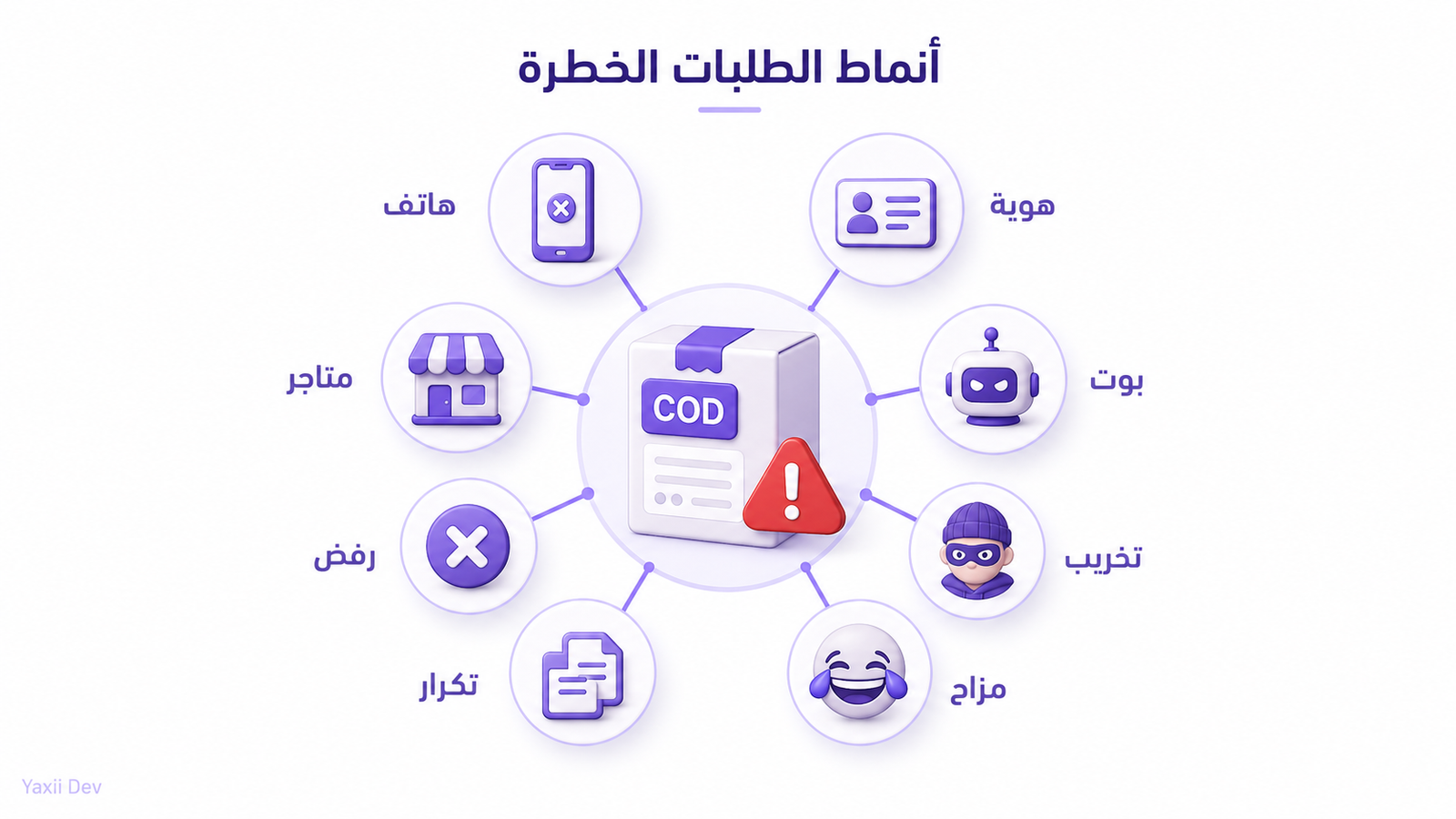
Eight real attack and abuse patterns affecting Algerian COD stores
1. Fake or unusable phone numbers
The simplest pattern is an obviously invalid phone number: the wrong number of digits, an impossible prefix, repeated digits, or a foreign format that does not match the order context.
Not every invalid phone number is malicious. A real customer may reverse two digits or forget one number. A good validation system should reject impossible formats while clearly showing the customer how to correct the mistake.
Primary protection: Algerian phone-format validation on both the browser and server side, number normalization, and confirmation before dispatch.
2. Using another person’s real identity
A more difficult attack uses a real name and real phone number belonging to someone who never placed the order.
From the merchant’s perspective, the information looks legitimate. The phone number exists and the person may answer. The problem only becomes visible when the person says, “I never ordered anything from your store.”
This wastes confirmation time and can damage the merchant’s reputation if the same person receives repeated calls or an unwanted parcel.
OTP verification can help in this scenario. It does not prove that the customer will accept the parcel, but it confirms that the person submitting the order controls the phone number at that moment.
3. Automated bot submissions
A bot can submit checkout data far faster than a human. A store may receive dozens or hundreds of orders containing random variations of names, phone numbers, products, and addresses.
Common warning signs include:
- a sudden spike in orders at unusual hours;
- multiple submissions within seconds;
- many requests from the same IP address or session pattern;
- unrealistically short checkout-completion times;
- customer data following the same repeated structure;
- missing or unusual browser user-agent information.
Primary protection: invisible honeypots, minimum completion time, interaction checks, reasonable request limits, and detection of suspicious browser signals.
4. Deliberate competitor abuse
A competitor may place fake orders to reserve stock, distort sales data, consume confirmation resources, or cause unnecessary dispatches.
These orders are harder to detect than simple bot submissions. They may contain valid Algerian numbers, realistic wilayas and communes, and believable customer names.
The pattern often becomes visible only through history: repeated refusals, similar addresses, repeated product combinations, or several high-value orders that never complete delivery.
Primary protection: structured confirmation, sensible order limits, number history, and accurate return-reason tracking.
5. Prank orders
A person may order after seeing a TikTok, Facebook, or Instagram advertisement without any genuine intention to buy. They may use their real phone number and then ignore every call.
One incident is not always enough to identify malicious behavior. Repeated unconfirmed orders or repeated refusals should trigger stronger verification.
Primary protection: internal order history, limits on repeated attempts, and confirmation before shipment.
6. Duplicate orders
Duplicate orders may come from a bot, a double-click, a slow connection, or a customer who did not immediately see the confirmation message.
Without protection, a store may prepare or even ship several identical parcels to the same customer.
Primary protection: submission locking, duplicate detection using phone, session, timing, and order contents, plus a clear success state after the first submission.
7. The customer confirms and then refuses the parcel
This is one of the most expensive COD outcomes. The customer answers the phone, confirms the order, and later refuses the parcel at delivery.
This behavior can be abusive, but it can also expose an operational problem:
- the final price was not repeated clearly;
- the customer did not understand the shipping fee;
- delivery took too long;
- the courier failed to coordinate the delivery;
- the customer ordered the same item from another store;
- the advertisement created expectations the product did not meet.
Primary protection: clear totals and shipping fees before submission, precise confirmation, delivery-status communication, and accurate return-reason tracking.
8. Serial buyers ordering from multiple stores
Some customers place the same order with several merchants, confirm several parcels, and accept only the first package that arrives.
Each order appears genuine when viewed separately. The pattern becomes visible only through repeated refusals or reliable order-history data.
Primary protection: internal reputation history, enhanced review for repeated cases, and a manual decision before dispatching high-risk orders.
Attack, warning sign, business damage, and first protection
| Attack or behavior | Main warning sign | Possible damage | First protection |
|---|---|---|---|
| Invalid phone number | Wrong format or unreachable number | Wasted calls and impossible delivery | Algerian phone validation |
| Identity misuse | The phone owner denies placing an order | Complaints, wasted calls, and trust damage | OTP or contextual confirmation |
| Bot submission burst | High volume and unrealistic completion times | Backend noise, load, and useless orders | Honeypot, timing checks, and rate limits |
| Competitor abuse | Believable orders followed by repeated refusal | Reserved stock, shipping loss, distorted reports | Structured confirmation and order history |
| Prank order | The buyer never answers or repeats the pattern | Confirmation time is wasted | Limits and stronger verification |
| Duplicate order | Same phone, product, and total within a short period | Double preparation or shipment | Duplicate detection and submission locking |
| Confirmed then refused | High refusal rate after successful confirmation | Outbound and return shipping costs | Clear total, return reasons, and history |
| Repeat high-risk customer | Several cancellations or refusals over time | Repeated operational loss | Internal reputation and manual review |
Abandoned checkout or fake order?
A customer who enters a phone number and then leaves the product page is not necessarily an attacker.
They may have been interrupted, lost confidence, wanted to compare delivery prices, or needed more information before completing the order.
Treating every incomplete checkout as fraud can cause a merchant to lose genuine sales opportunities.
| Event | Likely interpretation | Recommended action |
|---|---|---|
| Customer enters partial data and leaves | Abandonment or hesitation | Measured follow-up or UX analysis |
| Many ultra-fast submissions with inconsistent data | Automated abuse | Block and limit the source |
| Complete order with an unreachable number | Typing error, fake number, or weak intent | Validate and confirm |
| Confirmed customer with repeated refusals | Higher-risk behavior | Review history and decide manually |
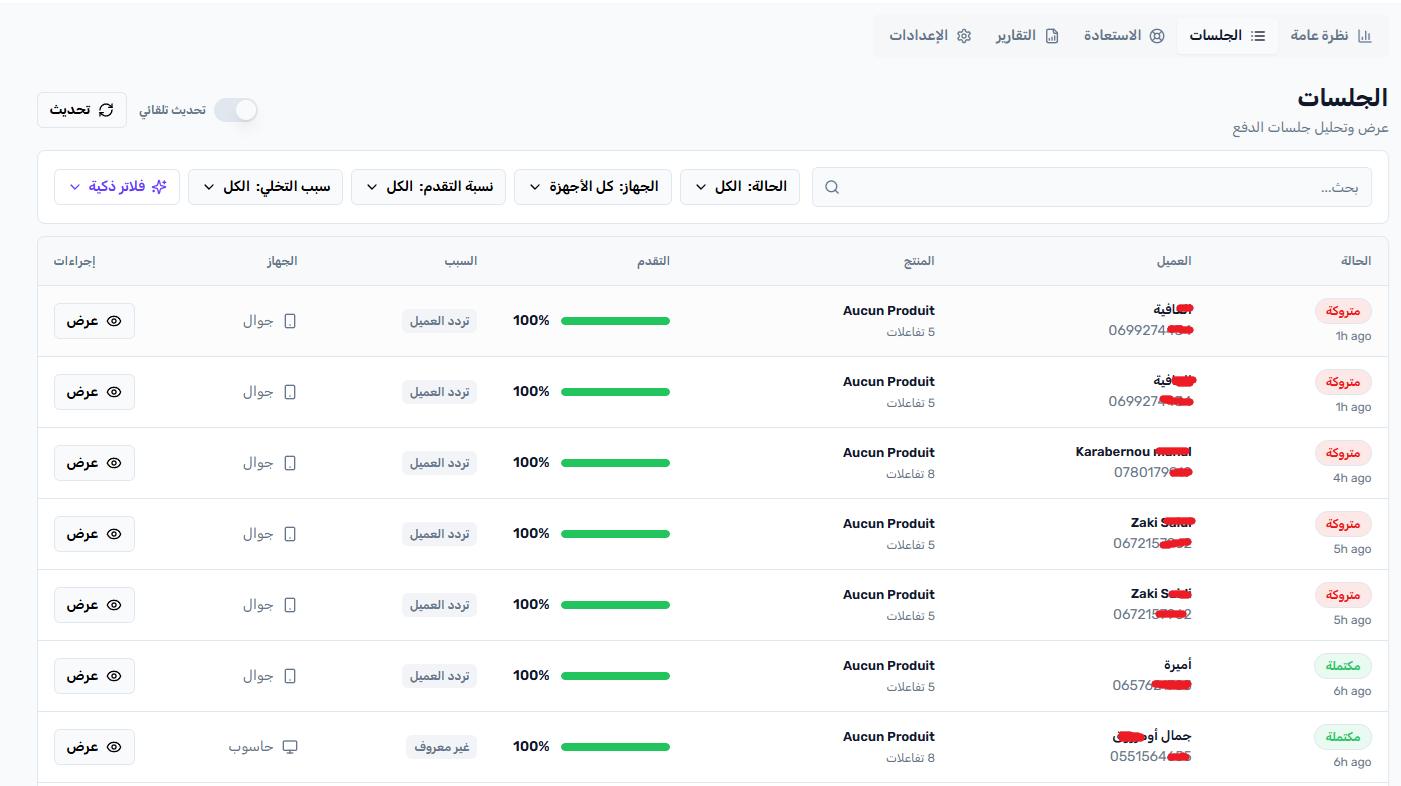
The abandoned checkout system in Yaxii Smart Form helps merchants separate incomplete buying journeys from orders that were actually created in WooCommerce.
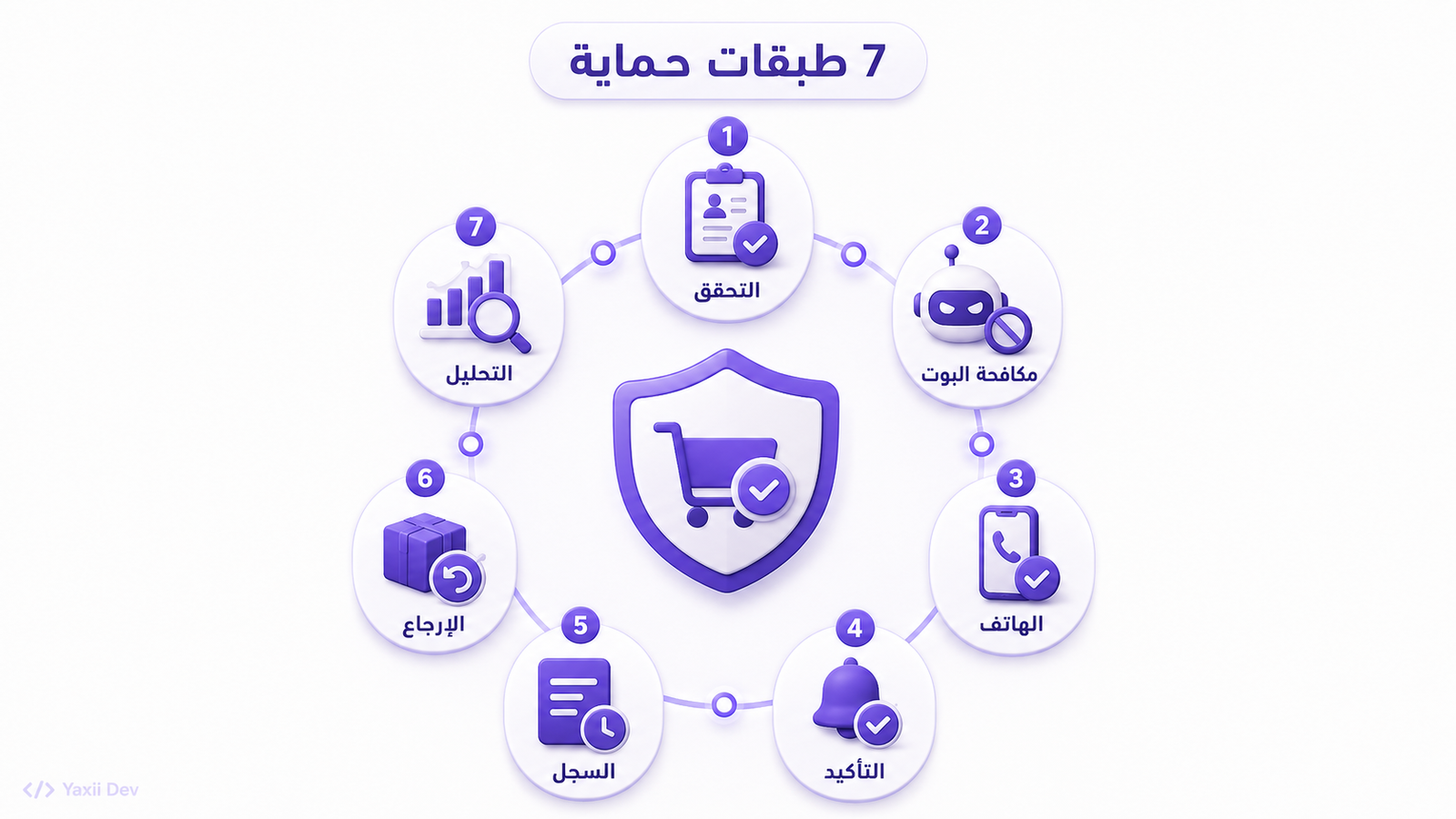
Seven layers of protection for an Algerian WooCommerce COD store
No single protection can solve every case. A CAPTCHA may stop some bots, but it will not stop a human competitor. OTP verifies the phone number, but it cannot guarantee parcel acceptance. A blacklist may stop repeat abuse, but it cannot identify a first-time attacker.
The strongest approach is layered defense.
- 1Validate customer data before creating the orderValidate the Algerian phone format, required fields, and the relationship between wilaya, commune, and delivery method.
This layer blocks obvious errors and unusable orders. It does not stop a malicious person using real customer data.
- 2Detect bots and automated submissionsUse invisible checks such as honeypots, minimum completion time, interaction detection, browser signals, and reasonable submission limits.
Avoid relying only on IP addresses. Mobile users may change addresses or appear behind shared network infrastructure, so IP should be one signal rather than the entire decision.
- 3Verify phone control when the risk justifies itFor expensive products, costly delivery regions, or suspicious behavior, verification through OTP, WhatsApp, or a phone call may be appropriate.
Do not automatically require OTP for every order. SMS delays or mobile-network issues can also block genuine buyers.
- 4Confirm the full order before dispatchConfirmation should cover the product, quantity, total price, shipping fee, wilaya, commune, and customer availability.
A simple “yes, I confirm” may not be enough. The customer should understand exactly what will arrive and how much they will pay.
- 5Build an internal history of customer outcomesRecord the outcome of each order: confirmed, unreachable, cancelled, duplicate, shipped, delivered, refused, or returned.
Do not classify a customer as abusive after one failed order. Look for repeated behavior and separate customer fault from courier or store failure.
- 6Track delivery and return reasonsAnalyze outcomes by wilaya, commune, courier, product, advertising source, and confirmation process.
A high return rate in one region does not automatically mean the customers are fraudulent. Delivery performance, timing, communication, and product expectations may be responsible.
- 7Measure campaign and traffic-source qualityConnect order outcomes to campaigns, ads, landing pages, and referral sources.
Do not optimize only for cost per order submitted. Measure cost per confirmed order and, where possible, cost per delivered order.
What WooCommerce protects—and what it does not understand about Algeria
WooCommerce provides a solid foundation for orders, statuses, customer data, and server-side validation. Its ecosystem also includes tools for phone normalization, checkout security, anti-spam protection, and request limiting.
However, default WooCommerce is not designed around the operational reality of Algerian Cash on Delivery.
Out of the box, it does not understand:
- the Algerian phone formats required by your confirmation team;
- the dependency between wilaya and commune;
- local home and office delivery workflows;
- shipping fees based on Algerian regions;
- the operational difference between an abandoned lead and a confirmed COD order;
- risk-based limits adapted to COD;
- the traffic patterns affecting product-page COD ordering.
General security plugins, a Web Application Firewall, or CAPTCHA can strengthen the website, but they do not replace local COD business logic.
For the shipping side of that workflow, see our WooCommerce shipping guide for Algeria by wilaya and commune.
Where Yaxii Smart Form fits into this defense
Yaxii Smart Form is not a generic form builder. It operates as a WooCommerce COD checkout and workflow layer for Algerian stores.
Its role is to improve order quality before bad data becomes an operational problem.
Before the order enters WooCommerce
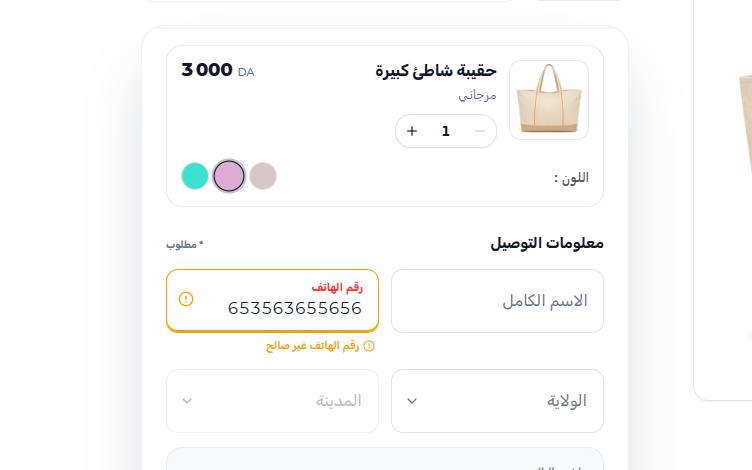
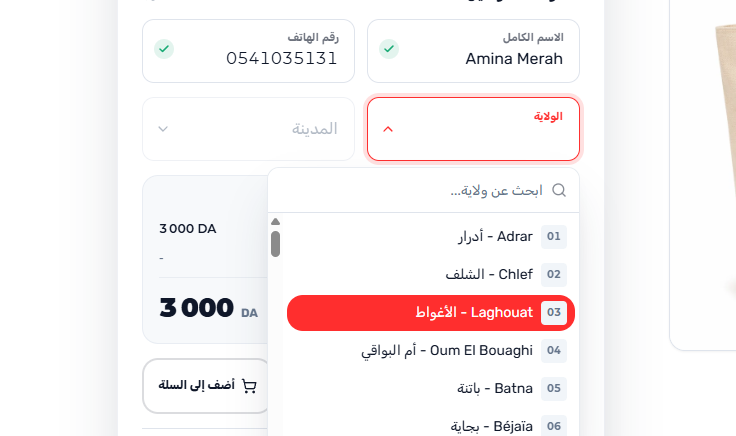
- Algerian phone-number validation;
- structured wilaya and commune fields;
- consistent shipping-method and delivery-fee logic;
- required-field checks;
- protection against unrealistic or automated submissions;
- configurable limits against repeated abuse.
When behavior becomes suspicious
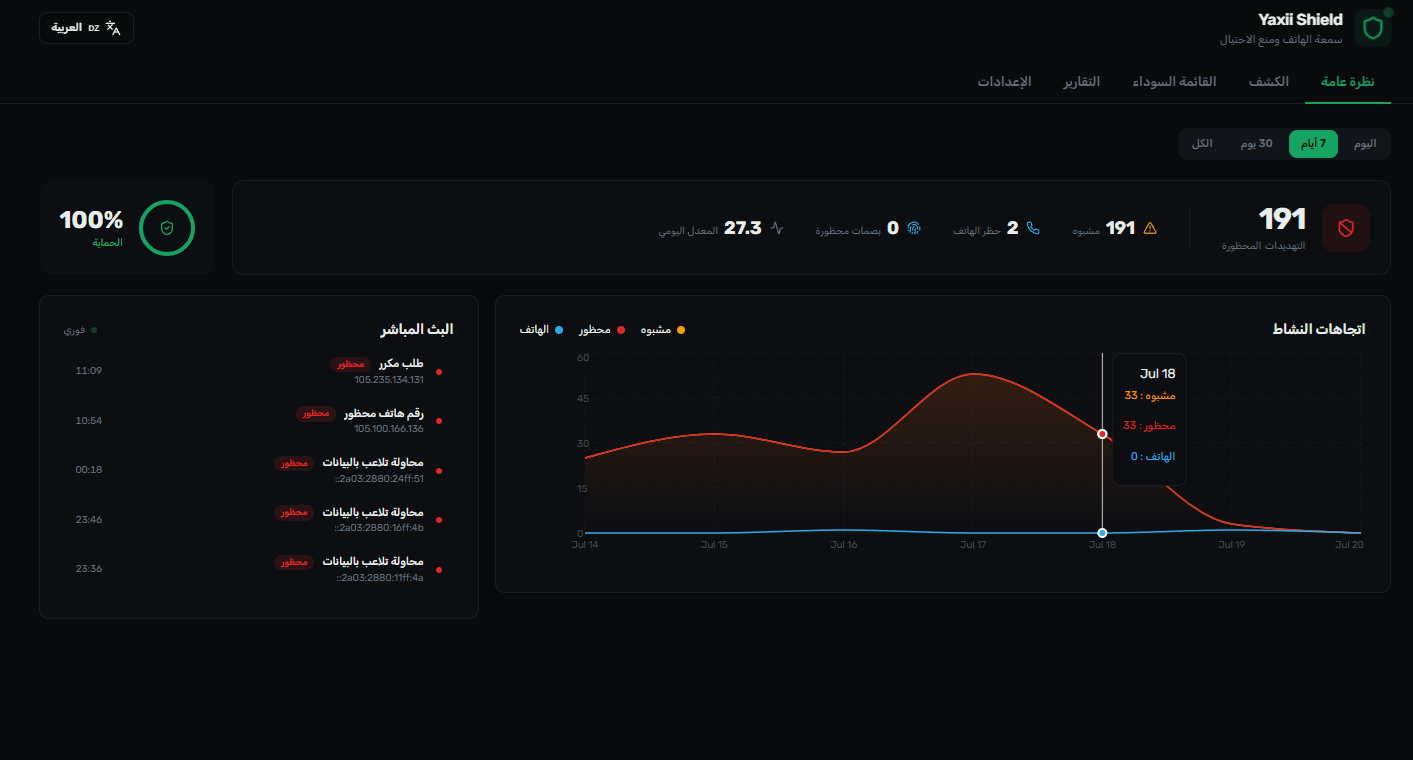
The Yaxii Shield security layer can apply lightweight controls without turning checkout into an obstacle course:
- very-fast-submission detection;
- invisible honeypot fields;
- interaction checks;
- filtering of suspicious technical signals;
- order and source limits;
- clear block messages when a rule is triggered;
- store-defined blocking of problematic phone numbers when appropriate.
Separating abandoned intent from completed orders
A customer may enter important details before leaving the product page. That does not automatically make the session malicious.
Abandoned checkout tracking helps merchants analyze those sessions separately, recover qualified leads, and avoid filling the main WooCommerce order list with incomplete intent.
A fifteen-minute COD security audit
You can quickly test whether your store is exposed to the most common fake-order risks.
- 1Test several invalid Algerian phone numbersTry numbers that are too short, too long, use an impossible prefix, or follow a foreign format. The checkout should reject clearly impossible data.
- 2Submit the same order twiceConfirm that a double-click or slow mobile connection does not create several identical orders.
- 3Check minimum completion behaviorAn order submitted instantly without realistic interaction should be treated as suspicious.
- 4Verify wilaya and commune consistencyEnsure that a commune cannot be attached to the wrong wilaya and that the shipping fee remains visible before submission.
- 5Inspect unconfirmed ordersLook for repeated phone numbers, repeated addresses, unusual time spikes, and customer data following the same pattern.
- 6Review confirmed orders that were refusedClassify the reason: price, shipping fee, delivery delay, unavailability, incorrect address, damaged parcel, or unexplained refusal.
- 7Compare advertising sourcesIdentify campaigns that generate many submitted orders but very few confirmed or delivered sales.
Blacklists, privacy, and false positives
Blocking a phone number can be useful when repeated abuse is clearly documented. It should still be handled carefully.
A customer may refuse an order because of:
- a serious delivery delay;
- a courier mistake;
- a damaged parcel;
- a price different from what was advertised;
- an incorrect address recorded by the store;
- a genuine personal emergency.
One failed delivery is not always enough to classify a customer as abusive.
Your privacy policy should also explain that limited technical data, such as IP address and browser information, may be processed to prevent abuse and secure orders.
What merchants should remember
Fake COD orders in Algeria are not one single problem. They include:
- bots and mass submissions;
- invalid phone numbers;
- identity misuse;
- deliberate competitor abuse;
- prank and duplicate orders;
- repeat high-risk customers;
- refusal after confirmation;
- operational failures incorrectly classified as fraud.
The strongest protection is layered. Improve data quality first, then add anti-bot controls, risk-based verification, confirmation, customer history, return analysis, and campaign-quality measurement.
Yaxii Smart Form can centralize much of the first line of defense for Algerian WooCommerce COD stores through phone validation, structured wilaya and commune selection, shipping logic, Yaxii Shield protections, and abandoned checkout separation.
Technology does not replace strong COD operations. It helps your team spend more time on real customers and less time processing noise.
Frequently asked questions
How can I reduce fake COD orders in Algeria?
Start with Algerian phone validation, structured wilaya and commune fields, anti-bot checks, confirmation before shipment, duplicate detection, and accurate return-reason tracking. No single layer is sufficient by itself.
Is OTP enough to stop fake COD orders?
No. OTP usually confirms that the user controls the phone number. It does not prove purchase intent and cannot prevent a verified buyer from refusing the parcel later.
What is the difference between abandoned checkout and a fake order?
An abandoned checkout usually represents incomplete intent: the buyer started the process but left before completing it. A fake order normally involves intentionally misleading data, automated submission, or repeated abusive behavior.
Is CAPTCHA enough to protect WooCommerce?
No. CAPTCHA may stop some bots, but it does not stop human abuse, malicious competitors, or repeat refusal behavior. It can also create mobile friction. Invisible behavioral protections are often better as the first layer.
Can I block a phone number after repeated refusals?
Yes, when your system supports it, but only after checking that the pattern is repeated and not caused by courier or store failure. Provide a review or contact path for possible false positives.
Why would a customer confirm an order and then refuse delivery?
Possible reasons include changing their mind, ordering from several stores, unclear shipping fees, delivery delays, bad coordination, misleading advertising, or deliberate abuse. Recording the actual reason is essential before deciding how to treat the customer.
Does Yaxii Smart Form guarantee the removal of all fake orders?
No. It adds several protections designed for WooCommerce COD workflows, but no solution can guarantee zero fraud, zero refusal, or zero human error.
Sources and references
- WooCommerce — Phone Validator and Formatter
- WooCommerce Code Reference — Validation
- WordPress.org — WooCommerce spam-order discussion
- OOPSpam — Limiting WooCommerce submissions
- DZBuild — Algerian COD fraud discussions
- DZBuild — Reducing COD refusal in Algeria
- Almawarid — Managing COD losses
- Mystoq — COD return-rate guidance
- OTPDz — Algerian OTP service example